
Squid Game 2: The Harsh Reality of Human Nature Explained

Squid Game 2: A Dark Mirror of Humanity
When Squid Game first landed on our screens in 2021, it shocked the world with its unflinching portrayal of human desperation, greed, and the lengths we go to survive. Now, Squid Game 2 is here, and it doesn’t just continue the story—it deepens its emotional and ethical complexities.
The bittersweet victory of Gi-hoon (Lee Jung-jae) has left him broken and hollowed by trauma, grappling with a truth: the cost of survival is more than money can ever pay.
It has him looking for a way to use the blood money to try and find the mysterious Squid Game recruiter by paying his previous creditor to scour the subway day and night.
Meanwhile, Detective Hwang Jun-ho (Wi Ha-joon), though presumed dead at the end of Season 1 is also feeling the impact of the trauma of the game. He has been searching the high seas for the island for the past two years with the captain who fished him out of the ocean.
Together, their journeys set the stage for a story that cuts deeper than its games, exposing the worst and best of human nature.
As with the first season, Season 2 doesn’t just entertain. It holds up a mirror, asking unsettling questions about the society that created these games and about the audience that watches them.
Greed and Survival: The Dark Psychology of Squid Game 2
Why Do We Chase Wealth?
The players of Squid Game come from different walks of life but share the same starting point: desperation. When life pushes them to rock bottom, the game finds them, like a shadow feeding on their last shreds of hope. It offers the cruelest bargain: redemption or ruin.
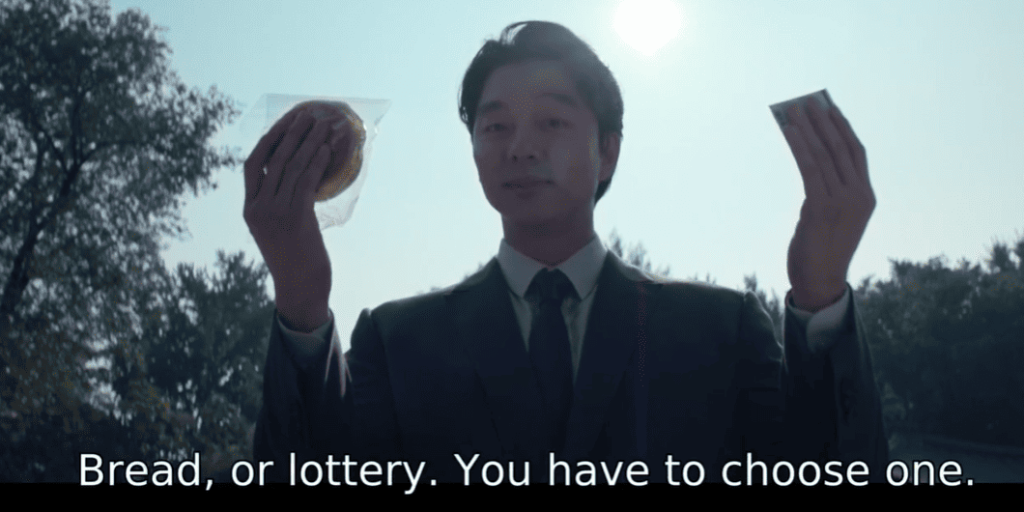
Take the subway recruiter’s bread-vs-lottery test, a cruel microcosm of the players’ plight. The way the recruiter (Gong Yoo) stomps the bread the homeless man rejects, signals the futility of any choice within a broken system.
It’s not really about hope, it’s about preying on those desperate enough to gamble with their lives.
Greed as a Double-Edged Sword
Greed can be transformative, but it is rarely kind. Gi-hoon’s relentless drive for revenge in Squid Game 2 costs him dearly. In Episode 1, his obsession leads to his creditor and his crony to be captured by the recruiter and forced to play a game of Russian Roulette.
The creditor choosing to let his crony survive adds a sobering dimension, when faced with death, humanity might prevail over self-interest.
The portrayal of greed as both survival and destruction when Gi Hoon also ends up playing Russian Roulette with the recruiter to prove that he was more than trash that had just crawled out of a dumpster.

In episode 6, during the Mingle game the players had to form groups on demand and gather in rooms together showed how quickly alliances crumbled under the weight of potential riches.
From YDG letting himself get dragged away from his own mother, the MG Coin player, Myeong Gi (Lim Si Wan) callously pushing the girl out of the room and Player 001 breaking someone’s neck for survival.
Greed turns players into predators, exposing the stark realities of survivalist instincts.
The “Prized” Illusion
The giant piggy bank, filled with 1 billion Korean won (roughly $680,000 )for every eliminated player looms like a beacon of false hope.
While the cash rains down, fueling cognitive dissonance, the players conveniently ignore one truth: everyone else must die for one person to claim the prize.
A fact that players casually ignore as they plot, scheme and even kill to avoid sharing the prize and taking control of the vote.
The piggy bank’s allure—a mirage of salvation—sustains the players’ delusion as they continue sacrificing morality and relationships for the slimmest chance at survival.
Desperation in Squid Game 2: How Far Would You Go?
Desperation Strips Humanity Away
Desperation unites the contestants, each grappling with heartbreaking realities. A mother fights for her son’s future —player 007 Park Young Shik (Yang Dong Geun) while unknowingly competing against him.
A pregnant woman clings to hope for her child while her crypto-obsessed ex seeks redemption. A father tries to save his daughter’s life through surgery he can’t afford.
Despite their human motives, desperation corrodes their sense of morality. In Episode 3, confusion during the “Red Light, Green Light” game leads to chaos and an avalanche of bodies—but the players’ eyes still glimmer with greed as cash rains into the piggy bank.
As the games proceed we see how the players start to look at each other as simply a means to an end.
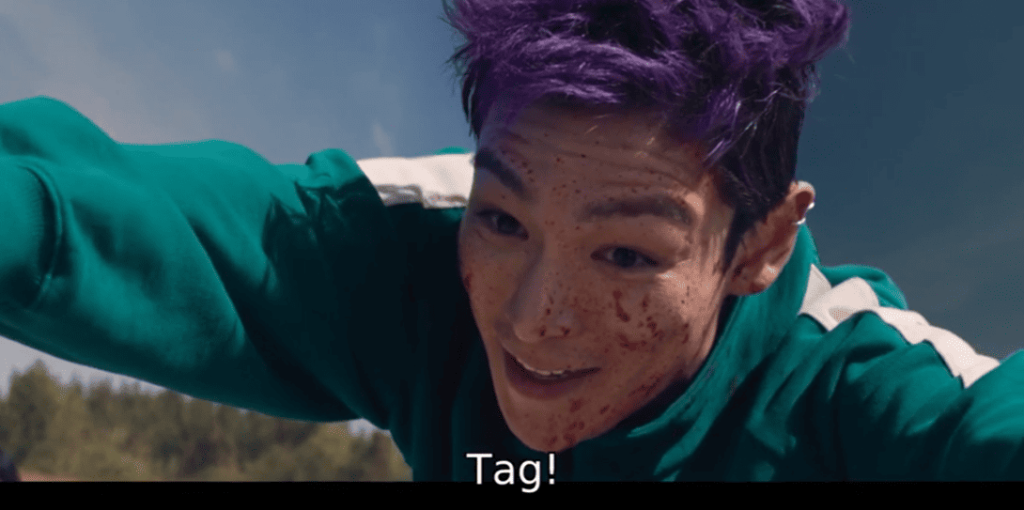
The crazy Thanos played by TOP is even wild in the first game, kicking others to their death and by the third game he even turns on his own friend during the Mingle game.
The players progressively lose their morality as they start to focus on survival and some of them start to refer to others as cockroaches. We all know that when you start dehumanizing other people it is carte blanche to do the unthinkable.

This leads to Gi Hoon and his allies to hide under their beds as the others start to stab each others ruthlessly with forks.
As regardless of winning games, if a life is lost by whatever means it doesn’t lose it’s 1 billion won value.
The games pit players against one another, and some descend into violence without hesitation. In Episode 7’s game, aptly named “Lights Out,” players stab each other with forks in the dark, transforming from victims to ruthless perpetrators.
The Guards: Compromised Morality
In episodes 3 and 4, even the guards of the games wrestle with their own ethical dilemmas. Soldier 011, No Eul, refuses to allow players’ organs to be harvested while still being complicit in their murders when they fail games.
The idea that she is willing to shoot a player when they lose the game, but unwilling to let them be taken half-alive and stripped of their organs like a vehicle being dismantled, highlights how desperation distorts morality.
This effect is seen not only in the participants but also in those enforcing the system
Trust, Betrayal, and Ethical Dilemmas in Squid Game 2
Moral Sacrifices Under Pressure
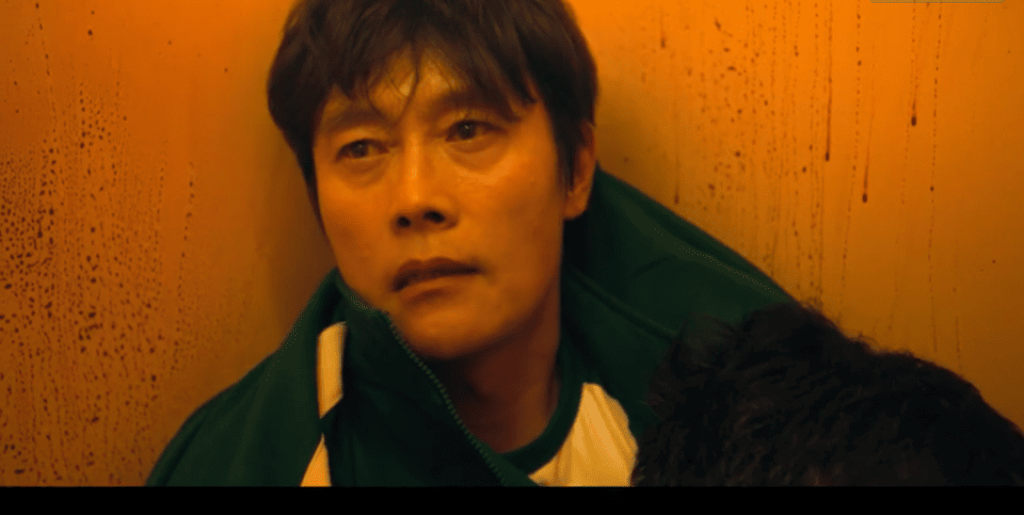
Squid Game 2 is rich with ethical dilemmas that challenge the very fabric of trust. Gi-hoon faces the choice of killing the recruiter during Russian Roulette but refrains, knowing it would compromise his moral crusade for justice.
Before the Mingle game in episode 6 called O X, Se mi (Won Ji An) made the mistake of confiding in Minsu (Lee David) that she thought he would never deceive her.
Only for Minsu to betray her during a game highlighting the fragility of human relationships when survival hangs in the balance.
These moments demonstrate how survival environments warp human behavior, transforming camaraderie into deadly calculation. The cost of self interest sees him cowering on a tower of beds, while watching Se-Mi’s gruesome death.
Friend or Foe? The Fine Line Between Allies and Adversaries
As alliances unravel in Episode 7, trust dissolves completely. Gi-hoon watches allies fall—both figuratively and literally—during the madness of Lights Out. These dynamics highlight a larger truth: when survival is the goal, trust becomes a liability.
Many characters in Squid Game 2 blur the lines between victim and perpetrator, mirroring real-world complexities.
At one point, Myeong Gi goes from being constantly targeted by Thanos only to brutally stab him in the neck with a fork—emphasizing that no one is untouchable in a lawless environment.
We have watched how Gi Hoon’s character has become much darker than in the previous season before he participated in the game.
He has transitioned into a morally ambiguous anti-hero who has given up on his family to get revenge against the game system.

Real-Life Reflections: What Squid Game 2 Says About Society
The Systematic Exploitation of Vulnerability
Ultimately, Squid Game 2 is more than a critique of individuals—it’s an indictment of systems. The players are meticulously exploited by the recruiters who prey on their vulnerability and desperation.
They deliberately target players who have insurmountable debt, people battling gambling addiction and the burden of crippling healthcare costs.
In episode 1, the creditor mentions how many of the debtors on his list have disappeared over the years showing that the games method of exploiting systemic poverty ensures the games never lack participants.
Capitalist Competition in Everyday Life
The betrayals and cutthroat competition echo the dog-eat-dog ethos of modern capitalism. This echoes real-world systems that prey on those most vulnerable, forcing competition that undermines solidarity.
Whether in the workplace, the housing market, or even basic healthcare, we often find ourselves trapped in the same desperation these players face—just in less literal arenas.
Glimmers of Humanity Amid the Chaos of Squid Game 2
Moments of Compassion Amid the Carnage
Amid the darkness, Squid Game 2 doesn’t entirely snuff out hope. In episode 3’s “Six Legs” we see players uniting under pressure although short-lived.
An old woman’s invitation to share a humble meal outside the games reminds us that humanity’s light can flicker even in dire circumstances.
These fleeting acts of compassion offer viewers a stark contrast to the surrounding brutality and show that even in our most desperate times, humanity is not entirely lost.
Lessons from the Blood-Soaked Games
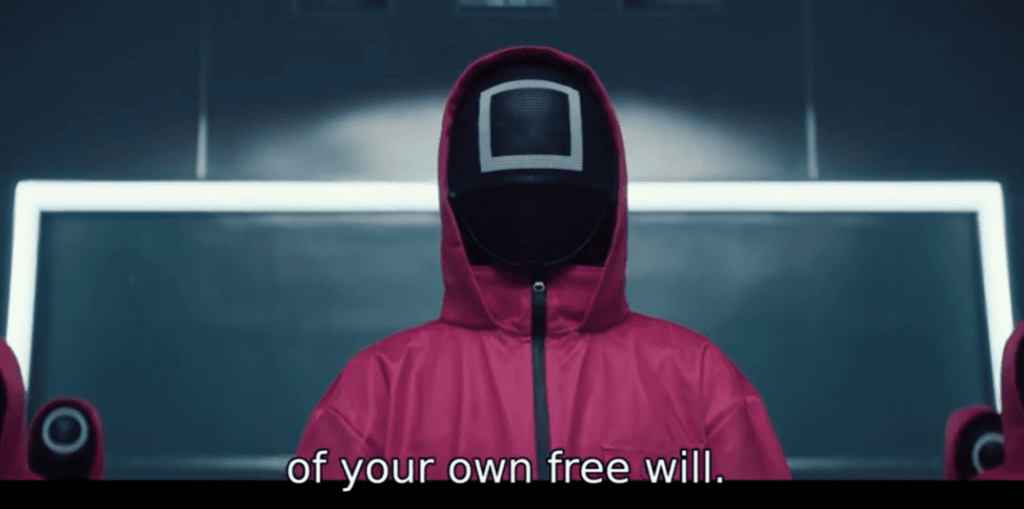
Squid Game 2 plunges deeper into the human psyche, forcing viewers to confront society’s systems and their own capacity for survival.
It cuts deep because it holds up a mirror to our world. Its games, its characters, its cruelty—they aren’t alien to us. They’re us, exaggerated but painfully familiar.
Through its blood-soaked trials, the series asks its viewers to reflect on what they value, what they believe, and what they’re willing to sacrifice to survive.
And perhaps, as we look into that mirror, the most unsettling realization is this: the game never really ends.
The game never really ends—but the conversation doesn’t have to either! Which moment in Squid Game 2 shook you the most?
Share your thoughts in the comments, and let’s explore the ethical dilemmas and societal truths behind the series together. Follow us for more breakdowns of the latest hits—we’d love to hear from you!
Squid Game 2 – Cast
Squid Game 2 Cast
Returning Cast:
Lee Jung-jae as Gi-hoon
The primary survivor of the first season, Gi-hoon is on a path of revenge and justice, driven by the trauma of his past experiences.
Wi Ha-joon as Hwang Jun-ho
The determined detective who survived the events of Season 1, now on a personal mission to uncover the truth behind the deadly games.
Gong Yoo as the Recruiter
The enigmatic figure who preys on vulnerable individuals to pull them into the horrifying games returns for an expanded role.
New Cast Members:
Im Si-wan as Myeong Gi
A brilliant but morally complex character, known as the “MG Coin Player.”
Yang Dong-geun (YDG) as Park Young Shik
A son competing alongside his mother, bringing deep emotional stakes.
Won Ji-an as Se-mi
A determined young woman navigating the games while trying to hold onto her humanity.
Lee David as Minsu
A seemingly trustworthy ally who blurs the lines between friend and foe.
T.O.P (Choi Seung-hyun) as “Thanos”
A chaotic and unpredictable contestant who thrives on creating chaos in the games.
Disclaimer: This blog is for informational and entertainment purposes only. All copyrights and trademarks for the TV shows, films, and other media referenced are the property of their respective owners. This blog aims to provide original commentary and insights and claims no ownership over third-party content.